Is your profit f’real?
I present an alternative bank account system to Profit First that may be easier for you to implement and maintain.
Recently, one of the business owners in Momentum Lab asked if we could spend part of our session on their bank accounts and the flow of money in their business. They had been running a version of Profit First for a while, and something about it wasn't sitting right with them.
If you haven't come across it, Profit First is a cash system built on one rule: take your profit off the top of every deposit, before the bills, so the business learns to live on what's left. Many founders use it, and I understand why. Plenty of people go years without paying themselves anything from their business, and a rule that forces you to do it helps.
The profit goes back into the business anyway
The problem, especially for newer businesses with low revenues, is that the process is complex, and you end up moving the same money around without actually paying yourself. This is because your business probably doesn't have enough money to pay you, no matter where you take it from. When money leaves the profit account one month and goes back into operations the next, it isn't really profit. It is a little silly to be setting aside profit before you have an emergency fund.
The goal: a healthy five-account version
The system I showed Momentum Lab uses five separate bank accounts, with thresholds that determine when the money is sufficient to move to the next account tier. The idea is to move profit only when it’s real profit, not imaginary profit, as in Profit First. Here is the basic idea, in the order the accounts get money along the way.
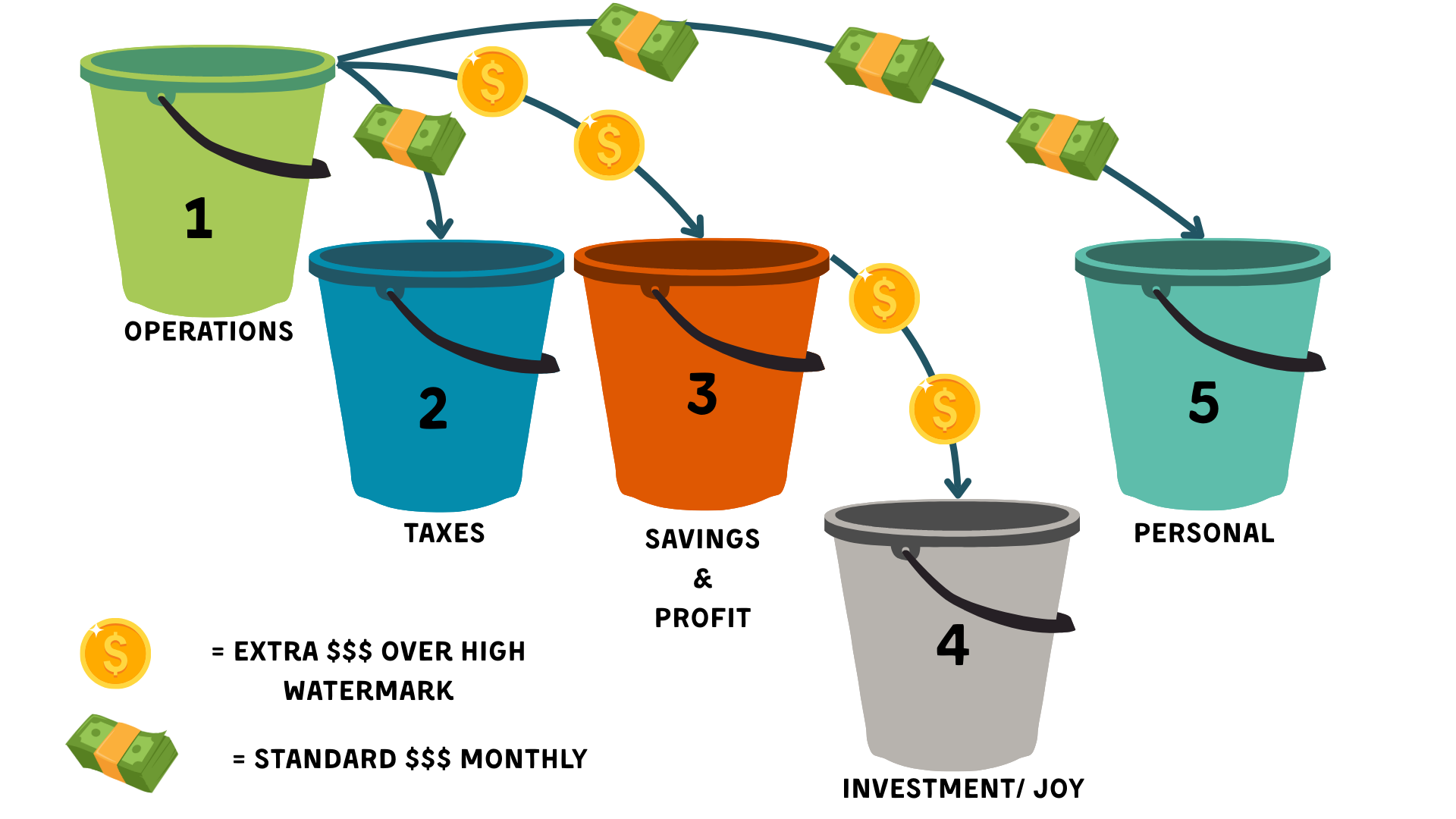
Operations Account (must be checking): all revenue goes here, and all bills come out. Set a threshold about 40% above the average monthly cost to run the business (e.g., if your costs are $10,000 per month, the threshold is $14,000).
Taxes Account: Monthly, you move over 20% of revenue from Operations. It sits here until you are ready to pay taxes. You can either pay them directly from this account or transfer the money over to the account that pays them at tax time. Now tax time isn't a scramble.
Personal Account: This and the investment account are ideally at a separate financial institution from your business accounts (clean separation). Set a monthly amount to pay for your life outside the business, once Operations can carry itself. It can be a salary or an owner distribution. If you consistently take money out of Operations and then put it back in, you are probably not ready to start paying or distributing from this account. That being said, I recommend setting up even small regular transfers each month ($100 minimum) to start the habit. Money goes here before it goes into Savings and Profit.
Savings and Profit Account: This starts filling once the Operations account is over its threshold (over $14K in this case), and the tax money is set aside. It doubles as your emergency fund, so you can borrow from it instead of your personal account. Lastly, you can safely invest in growth from this fund. It has a threshold of about 4X the Operations ceiling (roughly six months of operating costs; for the example above, that is $14,000 x 4 = $56,000). Once you're over that threshold and you're moving life money into the Personal account consistently, you start truly building wealth with the Investment & Joy Account (below). You really start to sleep well at night here.
Investment & Joy Account: This is the last account to fill because your business won't need these funds. Money moves here once the Savings and Profit Account reaches its threshold (over $56,000 in the example), and it doesn't come back into the business. This is your ultimate destination, and once you start adding money here, your business is fueling your life and securing your future. It takes a while to get here because filling Savings and Profit to its threshold takes four times your Operations ceiling. But with a healthy business, you can do it.
What makes this different from Profit First is the order: nothing gets called profit until the business can cover its own bills and taxes, which is the point where it's truly profit. Plus, the simplicity means you can really start to understand how the waterfall effect can improve your life, especially sleeping well at night.
Pro tip: put the threshold in the account name (e.g., Operations 14K), so it is easy to remember when you reach it.
Getting five accounts: Most credit unions (my preferred business banking) won't let you have multiple checking accounts, but you can set up many savings accounts.
What now?
Go forth and set this up for 2027, and you will be on your way to a clearer business and profit picture. If you need help starting, or you're running Profit First and catching yourself moving money backward, I'd be glad to look at your setup with you. Hit me up if you want to go deeper, or join Momentum Lab where we talk about business topics like this and more.